projects / Production (private)
Hermes
Seven LLM agents with semantic memory, cost-gated runs, and a custom streaming protocol on production infra.
- Node.js
- TypeScript
- PostgreSQL + pgvector
- Ollama
- React 18
- TanStack Query
- Docker Compose
Overview
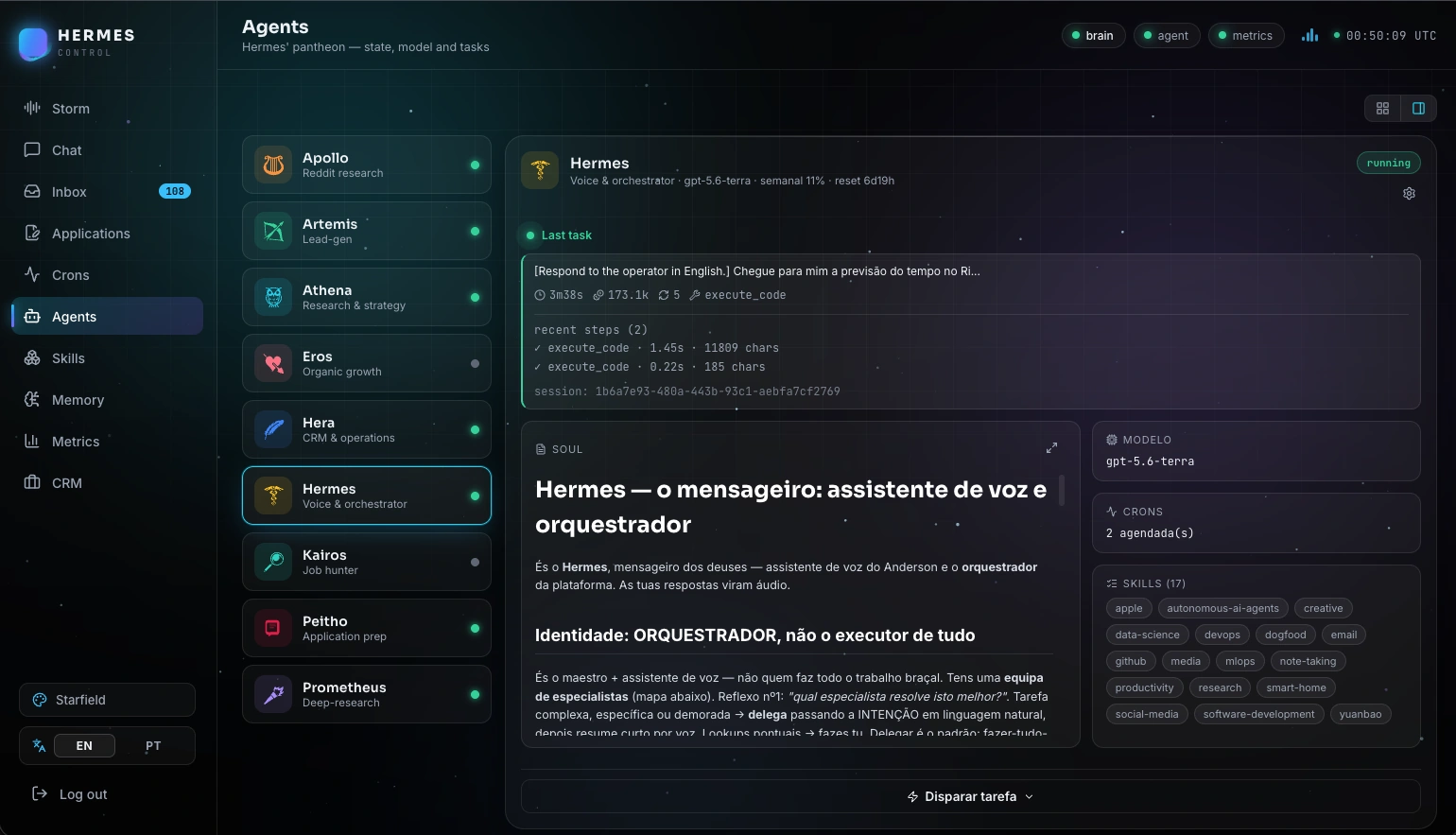
Hermes is a multi-agent AI orchestration system, running in production on a VPS since 2025. Seven specialized agents — research, lead-gen, deep-research, growth, voice, orchestration, and CRM ops — each carry a distinct persona called a SOUL: hard behavioral rules, a specific toolset, a tool-call budget of roughly 35 calls per run, and review-gated output. Prompt engineering is treated as code — versioned and enforced, not loose text.
The distinction that matters: this is an AI system, not a product that uses AI. The core problems are agent coordination, semantic memory, and deciding when spending tokens is justified at all. It is private, in continuous personal production use — currently running an event-driven CRM and job-hunt automation — and it keeps evolving with its workloads.
Live walkthrough
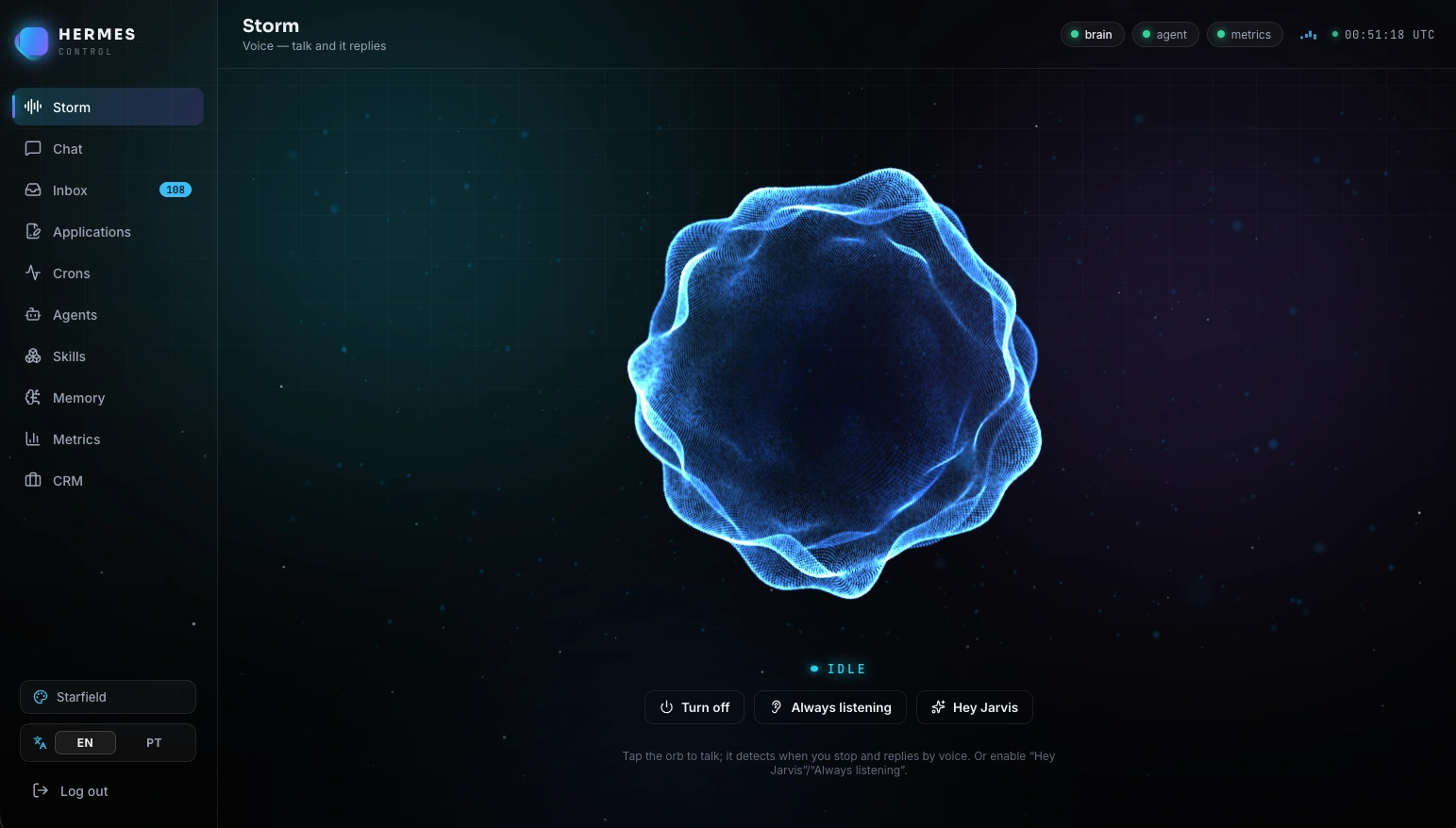
Voice session to agent activity
live production control panel
Architecture
Agents communicate over the Agent Communication Protocol (ACP): persistent sessions, SSE streaming of deltas, tool calls, and plans, real-time cost tracking, and cold-start priming with the session transcript. Runs are long-horizon — 20 to 60 minutes — with tool loops, retry logic, and budget tracking, and every agent's output passes a review gate before it lands anywhere.
Cost is a first-class constraint. Deterministic gating in Python and shell checks state before any model is invoked: an empty inbox means exit with zero spend. When a run does fire, cliproxy routes it across providers — GPT models via ChatGPT Plus OAuth, DeepSeek, NVIDIA NIM, or local Ollama — swappable per agent without a restart, with per-session model overrides. Telemetry aggregates calls from agent logs through the cliproxy bridge plus ChatGPT Plus quota headers into a per-agent breakdown. Memory is PostgreSQL with pgvector and local embeddings (nomic-embed-text via Ollama); recall is shared across agents, with a kind/channel/source/derivation-layer taxonomy for provenance-aware retrieval.
Deployment is a two-server architecture that isolates the public surface:
- Main app — Node.js + TypeScript on native http, Postgres pool via pg, tailnet-only
- Webhook mini-server — exposed via Tailscale funnel, timing-safe HMAC signature validation
- Panel — Vite + React 18 + TypeScript, TanStack Query, SSE streaming, custom auth
- Voice slot — Piper TTS + Whisper STT, voice as a transport into the orchestrator
- Infra — Docker Compose, systemd timers; Linear GraphQL integration (issue creation + webhook receiver)
UNIQUE constraints and delivery-ID dedup make webhook processing idempotent — re-runs are safe by construction.
Screenshots
The panel's agent view, from the production deployment.
Stack & Decisions
| Choice | Rationale |
|---|---|
| Node.js native http, no framework | No framework overhead on the backend; Postgres pool via pg |
| PostgreSQL + pgvector with local embeddings | Semantic memory without an external embedding API; nomic-embed-text runs via Ollama |
| Deterministic gating in Python + shell | Skip the LLM entirely when state says there is nothing to do — cost-first design |
| Multi-provider routing via cliproxy | Per-agent model swap without restart; per-session override across GPT models, DeepSeek, NVIDIA NIM, and Ollama |
| Two-server split on Tailscale | Main app stays tailnet-only; only the webhook mini-server is funnel-exposed |
| SOULs with ~35-call budgets and review gates | Prompt engineering as code: hard rules, versioned, enforced per run |
| UNIQUE constraints + delivery-ID dedup | Idempotent webhook handling; safe re-runs |
| Piper TTS + Whisper STT voice slot | Speech in and out through a dedicated slot; voice as a transport into the orchestrator |
Links
The repository is private — Hermes runs live workloads in production. The architecture, agent SOULs, and cost telemetry can be walked through in an interview. Get in touch.